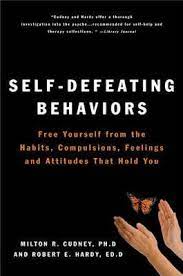
The Self Defeating Behavior book review will go into the basics of the authors, then jump into the breakdown of this book and how you can use the content it will provide for you.
Before I get started, I have to note that this is an older book, and you may or may not have heard of it, but if you are looking to break or simply understand your behavior, then this book could be just what you are looking for.
As you will soon see, this book goes in-depth on behavior and how we can free ourselves of bad behavior and build new habits.
If you would like to know more, stick with me as I go into the breakdown of this book, starting with information about the authors.
About The Authors:
Unlike most books I write articles about, this book has two authors. The collaboration of these two authors brings informed and detailed information on behaviors, how they are developed, and how you can break them.
The first author is Milton R. Cudney, and He was a professor of counseling at Western Michigan University in Kalamazoo, Michigan. He was the first to come up with the theory of how to defeat self-defeating behavior.
The second author is Robert E. Hardy, a licensed consulting psychologist with personal decisions, Inc, an international firm specializing in applying behavioral sciences to building successful leaders and organizations.
Together they would create techniques that would first be applied to their patients before writing this book together and showing anyone interested just how to change destructive behaviors step by step.
Now that you have some information about these authors, let me get into the breakdown of this book.
About The Book:
They start this book with an introduction to self-defeating behavior, which they break down over the first chapters. (They refer to this as Part one)
- What is a self-defeating behavior? Pages 9-18
- Your Life Systems. Pages 19-30
- The Toxic Culture. Pages 31-40
- It Starts with the conclusion. Pages 41-53
- The Model of self-defeat. Pages 54-62
They then go into part two, breaking down why self-defeating behavior is perpetuated. Finally, they take the following four chapters to detail this information.
- Living fearfully. Pages 65-74
- The forms that fear takes. Pages 75- 83
- Making choices. Pages 84-94
- Why do people choose to defeat themselves? Pages 95 – 102
From here, they go into part three, about how self-defeating behaviors are practiced, which they break down over the following four chapters.
- Self-defeating techniques. Pages105-117
- Prices. Pages 118-129
- Advanced Techniques 1: Disowning our behavior.Pages 130-143
- Advanced Techniques 2: Disowning our behavior. Pages 144-156
This is where they lead into part four and show us how to use all this information they will provide to free ourselves from the behaviors that are holding us back from living balanced and satisfying lives.
How To Use This Book:
Part four is all about how self-defeating behavior can be replaced. Again, they break this down over the final eight chapters.
- The road to breakthrough. Pages 159-168
- Identifying your self-defeating behaviors. Pages 169-177
- Your Trigger Patterns. Pages 178-185
- Know your techniques. Pages 186-193
- Catching yourself. Pages 194-201
- Developing Replacement Techniques. Page 202-213
- Analyzing Your Conclusions and Fears. Page 214-228
- Traveling the road to breakthrough. Pages 229-242.
They then close this book with some final thoughts, which you can find out if you choose to read it yourself.
If you use the techniques, they lay out for you in this book, you will permanently break old and dysfunctional behaviors and replace them with healthier and more positive ones.
You will also be more attuned to catching destructive behaviors in those around you as you rid your life of anything or anyone holding you back from your full potential and best self.
Final Thoughts:
If you can understand medical terminology to some degree and are not turned off by it, this book will give a next-level understanding of your behavior and why you function the way you do. On the other hand, if you are looking for an in-depth book, this is the one you want to read.
If you found this book review informative and enjoyed the content, please let me know by either giving it a like or leaving a comment below. Also, if you know someone who could gain from this information, please share this with them. Until next week, Namaste.

Leave a Reply